
If you are a business owner importing goods from China, I’m going to guess you’ve looked at your logistics options lately and felt completely stuck.
On one hand, ocean freight is taking forever, and with ongoing port congestions and shipping delays, you worry your cargo won’t make it in time for peak season. On the other hand, you check the price of direct air freight, and your jaw drops—it is simply too expensive to keep your profit margins alive.
My name is Allen, and after 15 years of helping overseas buyers navigate shipping from China, I’ve seen this exact dilemma play out dozens of times. But here is the good news: you don’t have to choose between “too slow” and “too expensive.”
There is a third path that many smart importers are quietly using right now. It’s called Sea-Air Multimodal Transport, and today, I want to explain exactly how it works and why it might just save your budget this year.
What Exactly is Sea-Air Freight?
I like to call Sea-Air the “best of both worlds” solution. It is exactly what it sounds like: a single shipping journey that uses both ocean and air transport to get your goods from China to your door.
Here is how we set it up for our clients, step-by-step:
Phase 1 (Ocean): We load your goods into a container at a major Chinese port (like Shenzhen, Shanghai, or Ningbo) and ship them via fast ocean vessel to a major global transit hub. The most common hubs are Dubai (for cargo heading to Europe or Africa) and Singapore or Incheon (for cargo heading to North America).
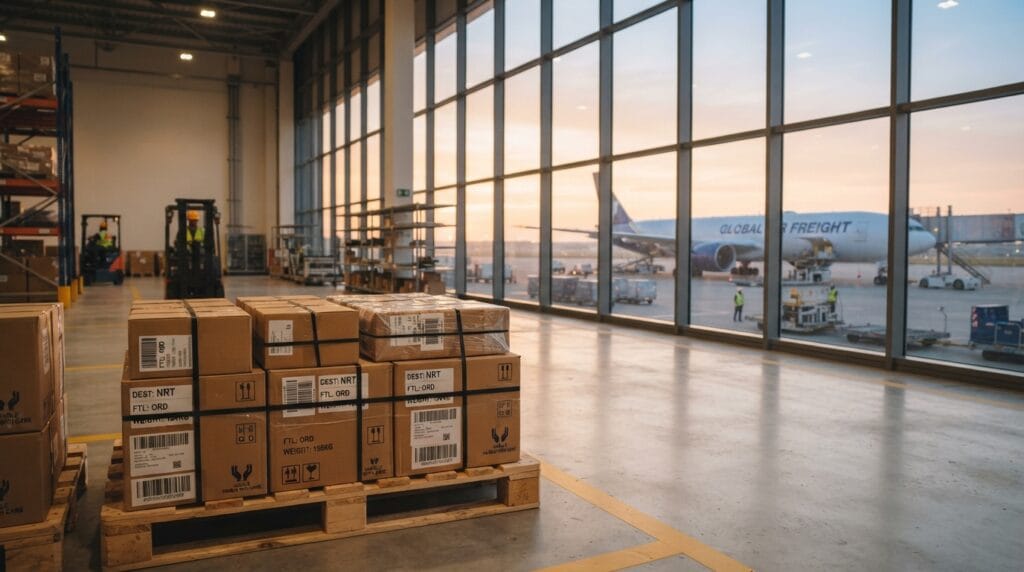
Phase 2 (The Transfer): Once the ship docks at the hub, our local partners immediately unload the container, clear transit customs, and transfer your goods to the airport. This usually happens in a swift 24 to 48 hours.
Phase 3 (Air): Your goods are loaded onto a cargo plane and flown directly to your destination airport for final delivery.
By combining these two methods, you break the traditional rules of logistics.
Why Choose Sea-Air? Let’s Do the Math
After 15 years in this industry, I don’t believe in selling services based on hype; I believe in looking at the real numbers. Let’s compare Sea-Air to the traditional options:
Compared to pure Ocean Freight: Direct ocean shipping from China to Europe or the US East Coast can easily take 35 to 50 days right now, especially with route diversions. Sea-Air cut that time nearly in half, usually delivering your goods in 15 to 22 days.
Compared to pure Air Freight: Direct air freight is fast (3 to 7 days), but it will eat up your entire profit margin. Choosing Sea-Air typically saves you 30% to 50% in costs compared to flying the goods the entire way.
It is the absolute sweet spot for what I call “high-stress, medium-value” goods. If you are shipping seasonal fashion, consumer electronics, or urgent holiday inventory that cannot wait for a slow boat but cannot afford a plane ticket, Sea-Air is your golden ticket.
Two Critical Mistakes to Avoid
Before you ask your forwarder to book a Sea-Air shipment, please keep these two insider tips in mind:
Your Packaging Must Be “Air-Ready”: Remember, your cargo is going to be loaded onto an airplane for the second half of the journey. Air cargo has strict weight and packaging rules. Please make sure your supplier in China uses sturdy, double-walled export cartons and strong plastic pallets. If your packaging is weak, it might get rejected at the airport transfer hub.
Choose a Forwarder with Strong Hub Connections: The biggest risk in Sea-Air shipping isn’t the ocean or the air—it’s the transfer in the middle. If your forwarder doesn’t have a reliable, fast-acting team on the ground in Dubai or Singapore, your goods could sit in a transit warehouse for a week. Always ask your logistics partner: “How fast can your team transfer my cargo from the seaport to the airport?”
A Final Friendly Thought
In my fifteen years on the ground here in China, I’ve learned that the most successful importers are the ones who stay flexible. When the shipping market gets tough, you don’t have to keep doing things the old way.
If you have an upcoming shipment and you’re worried about making your deadlines without breaking the bank, let’s talk. We can run the transit times and the costs for Sea-Air together to see if it’s the right fit for your business.
