
If you’re in international trade, logistics, or e-commerce, you’ve likely come across terms like CFS, CY, and FCL. For newcomers, these abbreviations can be confusing, and even experienced professionals may mix them up from time to time.
In this article, we’ll break down these essential shipping terms in plain English, so you can better understand how your cargo moves through the global supply chain — and make smarter decisions along the way.
What Is CFS?
CFS (Container Freight Station) is a facility where Less than Container Load (LCL) cargo is consolidated or deconsolidated. In simple terms, if your shipment doesn’t fill a full container, it’s grouped with cargo from other shippers at a CFS.
What Happens at a CFS?
Consolidation of LCL shipments before export
Deconsolidation of LCL shipments after import
Cargo labeling, palletizing, inspection, and temporary storage
Example:
You’re exporting a small batch of ceramic cups from Shenzhen to Los Angeles — just 1 cubic meter. It doesn’t make sense to book a full container, so your goods are sent to a CFS and combined with others in the same container.
What Is CY?
CY (Container Yard) refers to the container yard in a port or inland terminal where full containers are stored before being loaded onto vessels or after being discharged.
What Happens at a CY?
Pick-up and return of empty containers
Storage of full containers awaiting shipment
Official handover point between shipper and carrier
In practice:
If your bill of lading shows CY-CY, it means the shipping line is responsible for moving your goods from the container yard at the origin port to the container yard at the destination port — without opening the container along the way.
What Is FCL?
FCL (Full Container Load) means one shipper books an entire container for their cargo. It’s ideal when you have enough volume to fill a 20ft or 40ft container.
Benefits of FCL:
Greater security — no other shippers’ cargo in your container
Fewer handling steps, reducing risk of damage
Potential cost savings for larger volumes
Example:
You’re exporting 25 tons of furniture from Ho Chi Minh City to Hamburg. That volume justifies using one full 40ft container — making FCL your best option.
What Is LCL?
LCL (Less than Container Load) shipping allows you to share container space with other exporters or importers. You only pay for the space your goods occupy, making it cost-effective for small shipments.
Things to Keep in Mind:
Longer transit times due to cargo consolidation/deconsolidation
Higher chances of customs inspection
Risk of delays if other shippers’ cargo isn’t ready on time
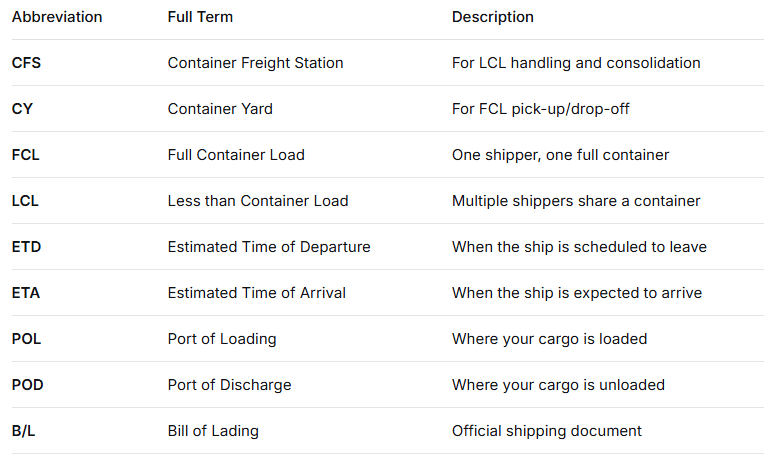
Quick Reference: Key Shipping Terms
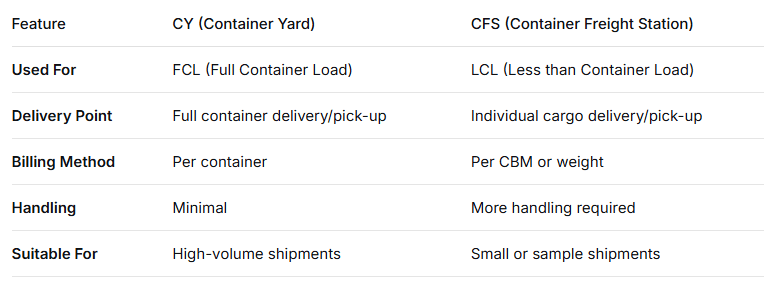
CY vs CFS — What’s the Difference?
Final Thoughts
Understanding shipping terms like CFS, CY, and FCL helps you avoid costly mistakes and communicate more clearly with freight forwarders and logistics providers.
Whether you’re shipping a single pallet or a full container, choosing the right shipping method can make all the difference in cost, speed, and reliability.
